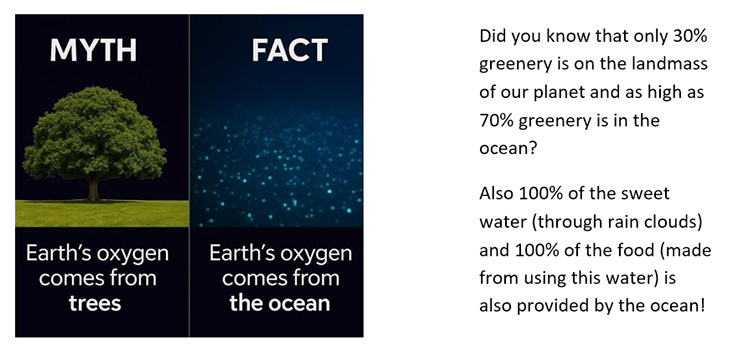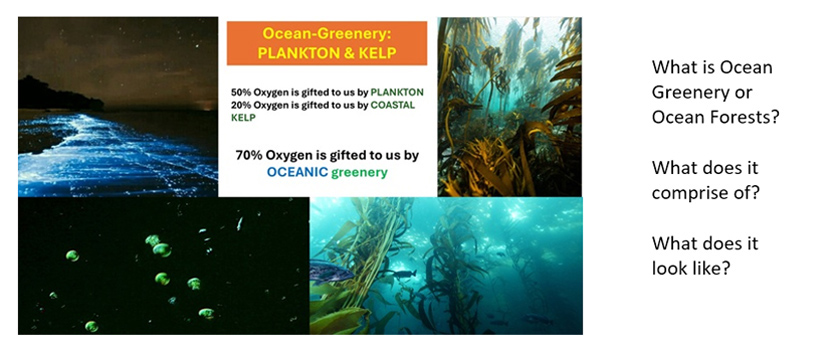
The invisible green treasures which thrive in salt water are called ‘Phytoplankton’, which is a moving forest and constitutes ~50% of the ocean forests. And the coastal forests comprising of ‘Kelp and Mangroves’ with roots submerged in salt water, form another ~20%.
In every single drop of ocean water, we can find up to 50,000 of these single cellular green trees. These Planktons glow at night.
These Phytoplankton seek sunlight for photosynthesis to produce the oxygen we need and they also provide food for the coastal Kelp forests.
We saw in the earlier post that 1/3rd of the ocean is already covered by plastic preventing sunlight reaching these planktons. Isn’t this a cause for concern? It is high time that we became aware of the ocean forest and the fact that every piece of plastic we throw is contributing to this danger of ocean forest depletion.
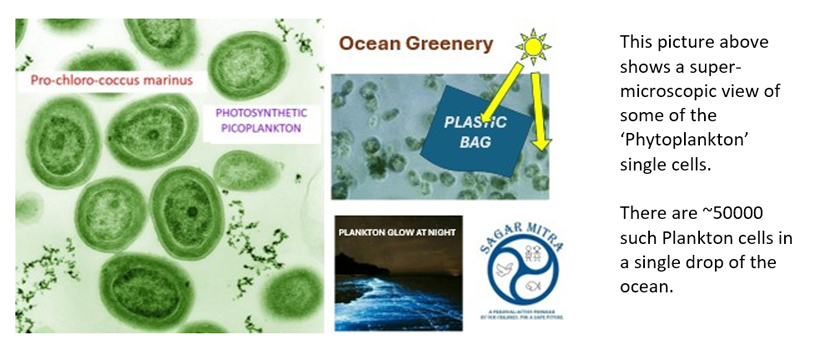
A simple plastic wrapper can cover many such drops of the ocean and kill greenery below it and deplete the oxygen supply. And we know that 1/3rd of the ocean surface is already covered with plastic.
Extracted Phytoplankton can also offer several benefits to humans by being a rich source of vitamins, minerals, and omega-3 fatty acids, which support cellular function, detoxification, and immune health.
How can we save Phytoplankton by preventing plastic from reaching the ocean / rivers?
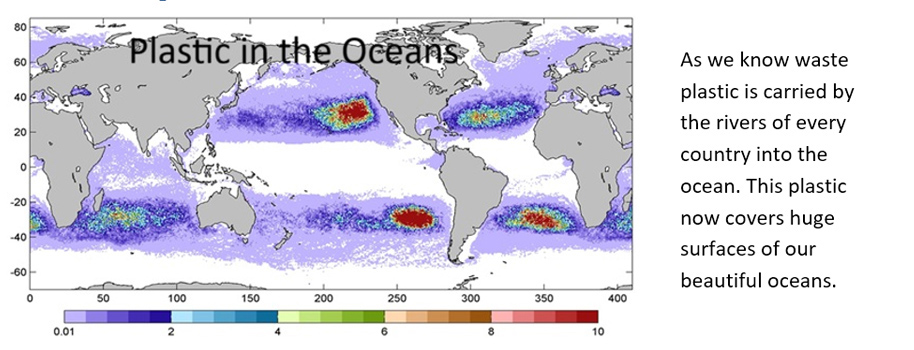
There is a '200 kms x 800 kms and 30 ft deep' floating plastic island created in the Pacific Ocean. And many more covering all other oceans.
- Total ocean area on our planet = ~360 million sq kms
- Total land area on our planet = ~150 million sq kms
- Total area already covered by plastic thrown by us in the ocean till now = ~120 million sq kms
- Total area covered by all the ~165000 rivers on our planet = <1 million sq km
This means that plastic is already covering I/3rd of the ocean surface preventing the sunlight from reaching the ocean greenery and aquatic life and killing it. Some estimates suggest this plastic coverage as high as 40%. You can do the maths to see how many times the rivers will get covered by this plastic?
Is someone going to clean this 120 million sq kms of plastic from the ocean? Does any country have a budget to get this cleaned? While we still hope that some technology comes to our rescue and this gets cleaned up, can we do something as individuals to prevent further damage?
While there is great awareness to preserve greenery on land and a lot of initiatives to plant trees on land, we are not aware of efforts being made to save the ocean greenery?
Do countries have budgets for keeping the oceans clean?
Some money is being spent to clean up inland rivers. There is effort to clean up some plastic on the oceans too, but are there ways in which we could prevent the ocean from becoming further unclean? Yes, Sagarmitra has an initiative which is run in schools as an attempt to mold young minds to think and use their karuna-sagar to prevent the ocean from further damage.
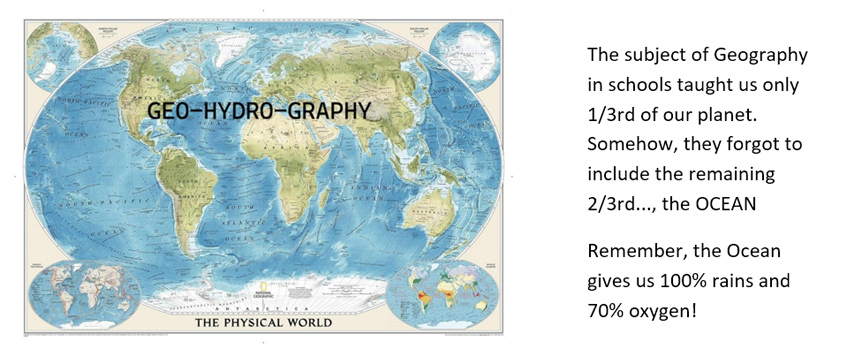
Isn’t it time to rename the subject of Geography as ‘Geo-hydro-graphy’ to include the 70% water body of our planet? And include study of the oceans as part of school curriculum?
So, let’s change Geography to Geohydrography! And Bhugol to Bhu-jala-gol! And let all school children know this.
This simple change will register the ocean in the minds of 1.5 billion school children across the world. And year after year the same number and their families will have a larger planet overview. And in a very short time, the entire population of the planet will know their larger ownership and responsibility for a balanced planet.
Are cyclones good or bad? Apparently, they are bad for the country, it’s people, infrastructure and economy.
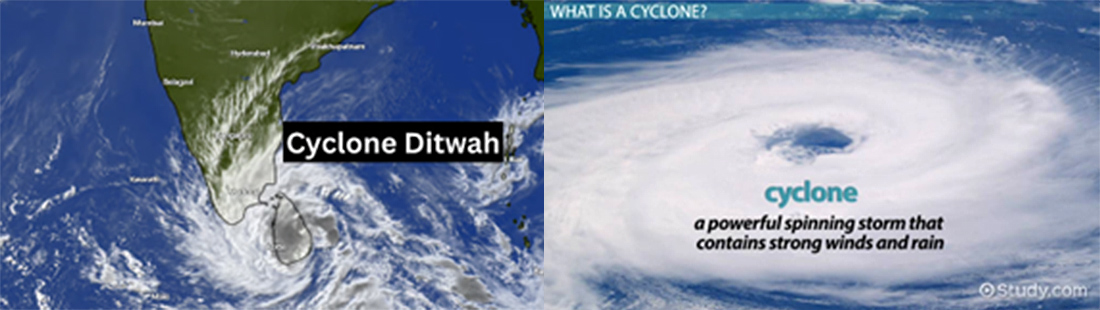
But cyclones provide a massive benefit to cool down the earth. We are suffering from global warming, and the ocean is making efforts for global cooling.
Every cyclone churns the ocean and brings cooler water from the depths to the surface and takes the warmer water below thus creating a cooling effect. It also helps maintains heat/cold balance between the equator and the poles.
A cyclone also helps expose more surface area of the water thereby helping further growth of phytoplankton, the ocean greenery.
The phytoplankton absorb carbon in the nature and release oxygen. The life span of a plankton is 2 to 3 days and on perishing the plankton takes the carbon with them and settles down to the bottom of the ocean as hydro-carbons.
This is nature’s way of keeping us cool and oxygenated. But it seems to be losing it’s effectiveness a bit due to the human superpower of releasing more carbon than what nature can handle.
But nature is trying to cope up with this new problem. While the absolute number of cyclones hasn’t gone up, the intensity of cyclones has definitely increased worldwide. And if we have more intense cyclones and hurricanes, the destruction on land will only grow.
Sagar Mitra volunteers are busy preparing the next generations to live lives better aligned with nature.